




Fitzgerald CDJR Hagerstown

Blog / 2026 eep Grand Wagoneer

Jeep Grand Cherokee vs. Jeep Grand Wagoneer: Which Jeep SUV Fits Your Family's Lifestyle?

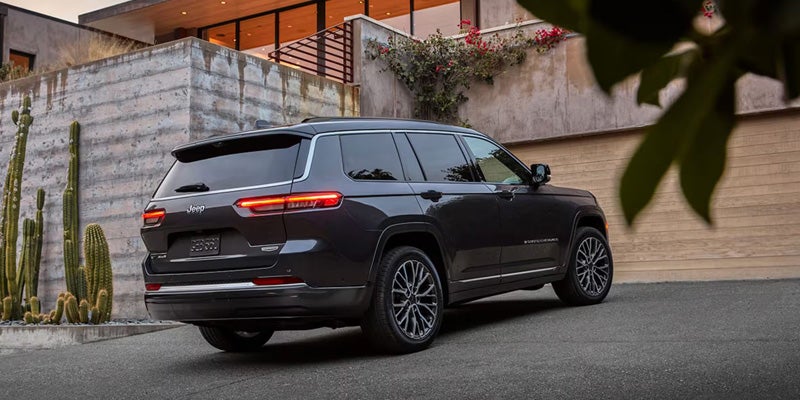
Black Grand Cherokee

When the adventurous family needs a feature-packed, capable SUV, you might find yourself torn between the Jeep Grand Cherokee vs. Jeep Grand Wagoneer. Both vehicles carry the legendary Jeep name and deliver serious performance, but they serve different types of drivers in Clearwater, Florida. Understanding how they compare can help you make a confident decision for your family.

The Jeep Grand Cherokee: Ruggedly Versatile

The Grand Cherokee is one of the most recognized names in the SUV segment. The 2026 model is available in both 2-row and 3-row configurations, giving you plenty of flexibility. The 2-row variant gives you an impressive 37.7 cu. ft. of daily cargo space to use, even when you’re traveling with a full house, and a max of 70.8 cu. ft., you can pack up everything from groceries and backpacks to camping gear for the whole family and the dog.

Standard features include connected navigation, Rear Park Assist, and class-leading performance from towing capacity to driving range. Designed to balance everyday comfort with genuine off-road prowess, the Grand Cherokee is as comfortable on Florida trails as it is in school pickup lines. It's one of the best Jeep SUV for families because of its manageable size and refined, tech-forward interior.

The Jeep Grand Wagoneer: Premium and Progressive

The Grand Wagoneer steps into a different category entirely. This premium 3-row SUV focuses on space, luxury, and presence. It's available in both standard and long wheelbase versions, which makes it a strong choice for larger families who need every inch of passenger and cargo room they can get. The 2-row variant offers seating for 8 and an everyday cargo area of nearly 28 cu. ft. That expands to 70.8, then 116.7 cu. ft. as you fold the rear rows down—the best in its class. The extended wheelbase, known as the Grand Wagoneer L, really amplifies that cargo area, with a massive 42.6 cu. ft. behind the 3rd row and a max of 121 cu. ft. with both rows folded flat. If you regularly haul sports gear, car seats, luggage, or a full crew of passengers, the Grand Wagoneer can handle it.

Inside, the Grand Wagoneer delivers an upscale experience with advanced tech features and generous seating, making it a strong pick for families who prioritize premium features and long-haul comfort. The available McIntosh® premium audio system with 23 speakers and adaptive 3D surround processing, for instance, takes your playlists to a whole new luxury level. Up to 75” of total screen space is available, encompassing an infotainment system with connected navigation that both front-row occupants can use, dual rear seat entertainment screens with Amazon Fire TV Built-in, and additional features like a rear-facing FamCAM™. Over 170 safety and security features are at your disposal, making parking, lane-changing, and traffic easier in this big SUV. With options for amenities like a tri-pane panoramic sunroof, Palermo leather upholstery, heated and ventilated seats, and more to go with the Best-in-Class 2nd-row legroom and other high-end features that come standard, this SUV urges you to take the long way home.

Key Differences to Consider

When comparing the Jeep Grand Cherokee vs. Grand Wagoneer, the differences come down to a few core factors: size, price, and intended use. The Grand Cherokee is more versatile for daily driving and offers a lower entry price. The Grand Wagoneer is larger, more luxurious, and suited for families that need maximum space and are willing to invest accordingly.

Both vehicles offer Best-in-Class capability and carry Jeep's reputation for durability and adventure-readiness. The choice isn't about which one is better—it's about which one fits your life better.

Which One Is Right for Your Family?

If your household has two to three kids and you want a refined SUV that handles both the daily commute and a weekend camping trip, the Grand Cherokee is likely your match. It offers the right blend of practicality and performance without going overboard on size.

If your family is larger, or you frequently travel with extended family and need more room throughout, the Grand Wagoneer makes sense. It's built for those who want a flagship-level experience and don't want to compromise on passenger comfort or cargo space.

Explore Your Options in Clearwater, FL

The Jeep Grand Cherokee vs. Jeep Wagoneer decision gets easier when you can see both vehicles side by side. Families throughout Clearwater, FL, can explore both models, compare trim levels, and find the configuration that fits their lifestyle at Fitzgerald CDJR Hagerstown anytime.
Posted in:

Related Posts

White Jeep Compass on road

Why Jeep® 4x4 Systems Still Set the Standard

Plenty of SUVs promise extra traction. Most do it with an AWD system that waits for the road to become slippery before sending power where it's needed. Jeep® has a different attitude. Its vehicles are designed from the start around purpose-built 4x4 systems, low-range transfer cases, locking differentials, skid plates, and suspension components that allow them to keep moving when the pavement ends. Jeep® Wrangler: The Benchmark for Trail Capability The 2026 Jeep® Wrangler remains the vehicle many enthusiasts compare every off-road SUV against. Buyers can choose between 2-door and 4-door Unlimited models, with the Unlimited seating up to 5 passengers and offering up to 72.4 cu. ft. of cargo space behind the front seats. The shorter wheelbase of the 2-door gives it exceptional maneuverability on technical trails, while the Unlimited provides additional passenger and cargo room for longer trips. The standard 3.6L Pentastar® V6 delivers 285 hp and 260 lbs. ft. of torque and is available with either a 6-speed manual or an 8-speed automatic transmission. An available 2.0L Turbocharged engine produces 270 hp and 295 lbs. ft. of torque, while the Wrangler 4xe combines a Turbocharged engine and electric motors for a total of 375 hp, 470 lbs. ft. of torque, and up to 21 miles of all-electric driving. Where the Wrangler really distinguishes itself is its choice of 4x4 systems. Command-Trac® is a proven part-time system designed for traditional off-road driving. Selec-Trac® adds the convenience of a full-time automatic mode for changing road conditions. Rock-Trac®, found on Rubicon models, features a 4:1 low-range transfer case that delivers outstanding control during rock crawling and steep descents. Rubicon models also include Dana® 44 heavy-duty axles, Tru-Lok® electronic locking front and rear differentials, an electronic front sway bar disconnect, and steel skid plates that allow the Wrangler to tackle terrain that would stop many SUVs long before reaching the trailhead. Jeep® Gladiator: A Pickup That Doesn't Stop at the Pavement The Gladiator shares much of the Wrangler's engineering but adds the versatility of a midsize pickup. Every 2026 Gladiator is powered by the 3.6L Pentastar® V6 producing 285 hp and 260 lbs. ft. of torque, paired with either a 6-speed manual or available 8-speed automatic transmission. Properly equipped, it can tow up to 7,700 lbs. and carry payloads up to 1,725 lbs., giving it capability that extends well beyond recreation. Its 5-foot steel cargo bed is designed to carry motorcycles, camping equipment, building materials, or outdoor gear without sacrificing passenger space inside the cab. Like the Wrangler, Gladiator Rubicon models feature Rock-Trac®, locking differentials, and disconnecting sway bars. Buyers interested in faster off-road travel should also consider the Mojave, which is engineered specifically for desert terrain with FOX® internal bypass shocks, reinforced frame components, and suspension tuning developed for higher-speed driving across rough surfaces. Jeep® Grand Cherokee: Everyday Comfort with Real Off-Road Credentials The Grand Cherokee takes a different approach. Rather than focusing solely on extreme trails, it combines premium comfort with genuine off-road capability. Available as both a 2-row Grand Cherokee and the 3-row Grand Cherokee L, it seats up to 7 passengers. The 2-row model provides up to 84.6 cu. ft. of cargo space, making it an excellent choice for families who travel with plenty of luggage or outdoor equipment. Power comes from the standard 3.6L Pentastar® V6 producing 293 hp and 260 lbs. ft. of torque. Buyers can also choose the Grand Cherokee 4xe, which generates 375 hp, 470 lbs. ft. of torque, and up to 25 miles of all-electric driving before switching seamlessly to hybrid operation. The Grand Cherokee offers three available 4x4 systems. Quadra-Trac I® is a full-time system requiring no driver input. Quadra-Trac II® adds a 2-speed transfer case with low range for more demanding conditions. Quadra-Drive® II builds on that with an electronic limited-slip rear differential capable of directing torque to the wheel with the most traction. Available Quadra-Lift® air suspension can raise the vehicle to increase ground clearance on the trail or lower it for easier passenger entry, while the Selec-Terrain® Traction Management System lets drivers tailor vehicle settings for snow, sand, mud, rock, and other conditions. Jeep® Compass: Compact Size, Standard 4x4 Capability The Compass proves that a smaller SUV can still offer genuine Jeep® capability. Every 2026 Compass is equipped with a Turbocharged 2.0L 4-cylinder producing 200 hp and 221 lbs. ft. of torque, paired with an 8-speed automatic transmission and standard Jeep® Active Drive 4x4. It seats 5 passengers and offers nearly 60 cu. ft. of cargo space with the rear seats folded, making it practical for daily errands, road trips, or outdoor recreation. Trailhawk® models add Jeep® Active Drive Low, increased ground clearance, skid plates, hill descent control, and all-terrain tires. These upgrades make the Compass more capable on dirt roads, snow-covered highways, and moderate trails than many compact crossover competitors. Capability Doesn't Mean Giving Up Modern Technology Today's Jeep® SUVs combine proven mechanical capability with technology designed for everyday driving. Depending on the model and trim, available features include the Uconnect® 5 infotainment system with displays up to 12.3 inches, wireless Apple CarPlay®, wireless Android Auto™, Connected Navigation, wireless phone charging, Alpine® or McIntosh® premium audio systems, and configurable digital driver information displays. Available safety technologies include Adaptive Cruise Control, Forward Collision Warning with Active Braking, Blind Spot Monitoring, Rear Cross Path Detection, Active Lane Management, ParkSense® Park Assist, and a 360-degree Surround View Camera. These systems make Jeep® SUVs just as comfortable on the morning commute as they are exploring remote trails. Choosing the Right Jeep® SUV Every Jeep® is designed around a different mission. The Wrangler remains the choice for drivers who prioritize maximum off-road capability and open-air freedom. The Gladiator combines that same trail performance with exceptional towing and pickup versatility. The Grand Cherokee delivers premium comfort without giving up genuine 4x4 capability, while the Compass offers standard four-wheel drive in a compact SUV that's easy to live with every day. If you're comparing additional models, exploring the complete Jeep® lineup or taking a closer look at Wrangler, Gladiator, Grand Cherokee, and Compass trim levels can help you decide which vehicle best fits your lifestyle. Explore Jeep® Capability at Fitzgerald Chrysler Dodge Jeep Ram Hagerstown Visit Fitzgerald Chrysler Dodge Jeep Ram Hagerstown today to compare the Jeep® lineup, explore available 4x4 systems, or schedule a test drive online to experience the capability that has defined the brand for generations.

Red Ram 1500

How Much Can the RAM 1500 Tow? A Complete Guide to Engines, Payload, and Towing

Hagerstown, Maryland truck drivers need to know that their workhorse can handle all their demands. If you've been wondering about the 2026 RAM 1500’s towing capacity and power, you won’t be disappointed. Whether you're hauling a boat, a camper, or a work trailer, you need to know exactly what your truck can handle before you buy so that you don’t go overboard or find out your truck doesn’t have the essential capability you need. This complete RAM truck towing guide breaks down everything you need to know about engines, payload, and capability. What Is the RAM 1500’s Max Towing Capacity? The 2026 RAM 1500 can tow up to 11,610 lbs. when properly equipped. That's a serious number for a half-ton truck, and it puts the RAM 1500 in strong standing for drivers who need real-world capability on a regular basis. Payload also reaches up to 2,360 lbs., so you have plenty of room to load the bed on top of whatever you're pulling. Of course, those maximum figures depend on the engine you choose and how the truck is configured so let's look at what's under the hood. Engine Options and Towing Capacity The 2026 RAM 1500 gives you 4 engine choices, each suited to a different type of driver and different types of demands. The standard 3.6L Pentastar® V6 with eTorque mild hybrid tech is a proven workhorse that handles everyday loads of up to 8,130 lbs. with ease. Stepping up, you'll find 2 available 3.0L Hurricane engines that push performance further, with the High-Output version delivering a monstrous 540 hp and 521 lbs.-ft. of torque. However, the standard Hurricane, though it delivers 420 hp and 469 lbs.-ft. of torque, can tow more at up to 11,610 lbs., while the HO Hurricane maxes out at 10,000. For those who prefer the familiar rumble of a V8, the 5.7L HEMI® V8 is back, delivering 320 hp and 410 lbs.-ft. of torque and an 11,320-lb. towing capacity. Pair the HEMI® with trims like the Rebel® X for superior off-road muscle as well. Your engine selection is one of the most important decisions in building the right towing setup for your lifestyle. Understanding Payload Towing capacity gets most of the attention, but payload is just as important to understand. Payload refers to how much weight you can carry inside the truck itself passengers, gear, and anything in the bed. The 2026 RAM 1500 handles up to 2,360 lbs. of payload, but keep in mind that your payload rating affects your towing capacity. If you're adding passengers or heavy cargo in the cab and bed, that counts against your total payload allowance. Reading your truck's specific payload placard is always the right move before hooking up a trailer. 2026 RAM 1500’s Towing Technology This model year offers the most available towing technology features ever on the RAM 1500. That includes more than 100 standard and available safety and security features designed to give you confidence whether you're backing into a campsite or merging onto the highway with a loaded trailer. The integrated trailer health monitor provides updates and performance info in one place at one time, eliminating guesswork. Trailer Reverse Guidance highlights your trajectory as you back up with dynamic gridlines to avoid jackknifing. The available digital rearview mirror activates when you select Tow Mode, giving you a live video stream from a trailer-mounted rear-facing camera, while Trailer Hitch Assist lets the truck steer itself into alignment while you focus on the pedals. The available digital displays, totaling more than 50” across select trims, give you a clear, real-time view of your towing data. Choosing the Right RAM 1500 Trim for Towing With trims ranging from the Tradesman to the Tungsten, there's a RAM 1500 configured for nearly every towing need. Off-road-focused options like the Rebel® and the Backcountry add features such as raised ride height, underbody skid plates, and all-terrain tires great for drivers who tow to remote destinations. For workhorse capability paired with premium comfort, the Limited and Limited Longhorn™ offer a refined experience without sacrificing hauling muscle. Stop By Fitzgerald Chrysler Dodge Jeep RAM Hagerstown Today! Drivers near Hagerstown, MD who want to explore the full lineup can visit Fitzgerald Chrysler Dodge Jeep RAM Hagerstown online at fitzmallcdjrhagerstown.com to browse current inventory and find the trim that fits their towing needs best.

Jeep Gladiator on road

Jeep® Wrangler or Jeep® Gladiator? It Depends on What You're Bringing Along

The Jeep® Wrangler and Jeep® Gladiator have a lot in common. Both can remove their doors and roof. Both are Trail Rated®. Both are perfectly happy climbing over rocks that make most SUVs rethink their life choices. The biggest difference isn't capability. It's what happens after you get there. If your idea of a great weekend involves finding the trail with the fewest pavement markings, the Wrangler makes a strong case for itself. If your adventures also require hauling a dirt bike, a kayak, or enough camping gear to survive an extended weekend, the Gladiator starts looking very convincing. For drivers around Hagerstown, MD, here's how they compare. The Wrangler Keeps Things Nimble The Jeep® Wrangler is available as either a 2-door model or the 4-door Wrangler Unlimited, giving buyers flexibility based on how much passenger and cargo space they need. The Wrangler Unlimited seats up to 5 passengers and provides 31.7 cu. ft. of cargo space behind the second row. Fold those seats down, and cargo capacity expands to 72.4 cu. ft., leaving plenty of room for coolers, backpacks, camping gear, or the collection of things your kids insisted were absolutely essential. Power comes from the standard 3.6L Pentastar® V6, producing 285 hp and 260 lbs. ft. of torque. Buyers can choose a 6-speed manual transmission or an available 8-speed automatic. An available 2.0L Turbocharged 4-cylinder generates 270 hp and 295 lbs. ft. of torque for drivers looking for stronger low-speed response. When properly equipped, select 4-door Wrangler models can tow up to 5,000 lbs., making them capable of pulling small campers, fishing boats, or utility trailers. The Gladiator Adds a Truck Bed Without Losing Its Jeep® DNA The Gladiator shares much of its architecture with the Wrangler, but everything changes behind the rear seats. Instead of an enclosed cargo area, there's a durable 5-foot steel pickup bed that opens the door to hauling motorcycles, mulch, lumber, bicycles, paddleboards, or the inevitable home improvement project that somehow started with, "This should only take an hour." Like the Wrangler, the Gladiator seats 5 passengers and is powered by the 3.6L Pentastar® V6 producing 285 hp and 260 lbs. ft. of torque, paired with either a 6-speed manual or available 8-speed automatic transmission. Where it separates itself is capability. Properly equipped Gladiator models tow up to 7,700 lbs. and carry payloads up to 1,725 lbs., numbers that place it among the most capable midsize pickups available. If your weekends regularly involve trailers or equipment, the Gladiator earns its keep before the trail even begins. Both Are Built for the Trail Capability has never been the question with either of these vehicles. Available Command-Trac®, Selec-Trac®, and Rock-Trac® 4x4 systems allow buyers to choose the drivetrain that best fits their driving habits. Higher trims like the Rubicon include features such as Tru-Lok® electronic locking differentials, an electronic front sway bar disconnect, Dana® heavy-duty axles, steel skid plates, and Off-Road+ Mode. The Wrangler's shorter wheelbase gives it an advantage when tackling steep breakover angles and tighter obstacles. It simply changes direction more easily on technical trails. The Gladiator is longer, which means it gives up a little maneuverability, but the payoff is the ability to carry far more gear into remote locations without relying on a trailer. Modern Comfort Comes Along for the Ride Gone are the days when owning a Jeep® meant accepting bare-bones technology. Available features on both models include a 12.3-inch Uconnect® 5 touchscreen, wireless Apple CarPlay®, wireless Android Auto™, Connected Navigation, an Alpine® premium audio system, wireless phone charging, multiple USB-A and USB-C charging ports, and a configurable digital driver information display. Available safety technologies include Adaptive Cruise Control, Forward Collision Warning with Active Braking, Blind Spot Monitoring, Rear Cross Path Detection, ParkSense® Rear Park Assist, ParkView® Rear Back-Up Camera, and Automatic High-Beam Headlamps. The Gladiator also benefits from its longer wheelbase by offering slightly more rear-seat legroom and additional interior storage, something passengers tend to appreciate after several hours on the road. So Which One Fits Your Lifestyle? The Wrangler is the better fit for drivers who want maximum off-road agility, an enclosed cargo area, and the flexibility of choosing between two or four doors. It's built for exploring trails first, with everyday practicality close behind. The Gladiator appeals to buyers who want that same legendary Jeep® capability but need the versatility of a pickup. Its towing capacity, payload, and open bed make it equally comfortable on a work site, a campsite, or a mountain trail. If you're comparing additional models, exploring the complete Jeep® lineup or taking a closer look at Wrangler and Gladiator trim levels can help narrow your decision. Compare the Wrangler and Gladiator at Fitzgerald Chrysler Dodge Jeep Ram Hagerstown Both Jeep® models are exceptionally capable, but they solve different problems. One excels at squeezing through narrow trails with remarkable agility. The other arrives carrying everything you wanted to bring along. Visit us today to compare both models side by side, explore trims like Rubicon and Mojave, or schedule a test drive online right now to find the adventure vehicle that best fits the way you travel.